
Implementation Project and Agile Development: How Two Worlds Meet in IT Projects
One of the most common misunderstandings in technology programs is the belief that formal implementation documents and agile delivery artifacts duplicate each other. In reality, they operate at different levels and serve different audiences.
The role of the implementation project
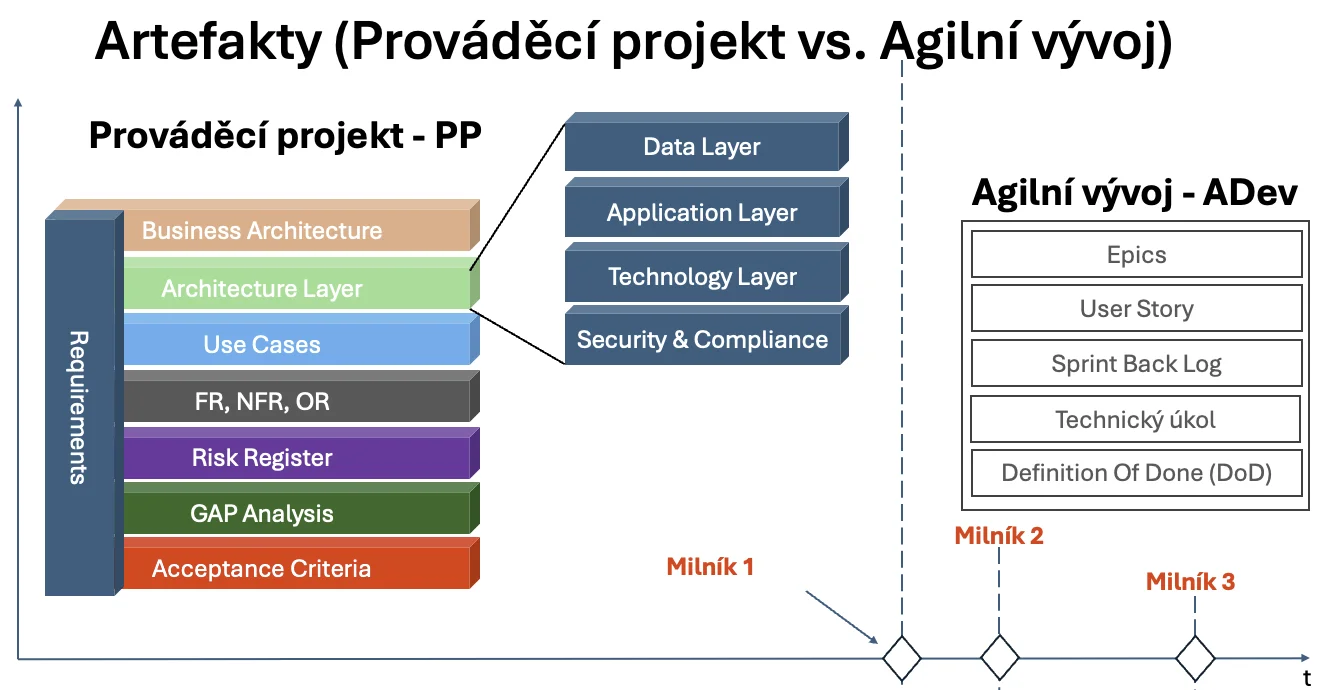
The implementation project is the contractual and governance layer of delivery. It provides the formal structure that customers, management, and regulatory stakeholders need in order to understand what is being delivered and how the scope will be controlled.
It commonly includes:
- functional and non-functional requirements
- use case catalogues
- architectural and integration models
- GAP analysis between current and target state
- milestones and schedule
- acceptance criteria
- risk management artifacts
This layer answers a simple but critical question: what exactly are we committing to deliver?
The role of the agile backlog
Development teams work at a different granularity. They need delivery units that are small enough to estimate, implement, test, and adapt.
That is where the backlog comes in:
- epics capture broader business outcomes
- user stories translate those outcomes into user-facing scenarios
- acceptance criteria define testable expectations
- technical tasks break work down into implementable units
- sprint backlogs organize the next increment of delivery
This layer answers another essential question: how do we move from scope to working software step by step?
A practical comparison looks like this:
| Implementation project | Agile development |
|---|---|
| Defines formal scope and governance commitments | Organizes incremental delivery work |
| Works with requirements, use cases, architecture, GAP analysis, risks, and acceptance criteria | Works with epics, user stories, sprint backlogs, technical tasks, and DoD |
| Optimized for management, contractual clarity, and auditability | Optimized for execution, adaptation, and day-to-day delivery flow |
| Describes the governed whole | Drives the path toward working software |
Traceability is the bridge
The bridge between these two worlds is traceability.
A good traceability model ensures:
- each contractual requirement has a corresponding implementation path
- nothing disappears between analysis and delivery
- testing and acceptance can be traced back to the original scope
Without traceability, formal documentation becomes disconnected from real execution. Without structured delivery artifacts, agile teams risk moving quickly without enough control.
Why this matters in enterprise and public-sector delivery
In regulated, enterprise, and public-sector environments, both layers are necessary.
- management needs visibility, compliance, and scope control
- customers need evidence that contractual commitments are preserved
- delivery teams need workable, iterative units that support real progress
Treating the implementation project and agile backlog as complementary rather than competing creates a delivery model that is more transparent, more governable, and ultimately more practical.
Closing view
The implementation project and the agile backlog are best understood as two views of the same system.
The implementation project describes the governed whole.
The agile backlog drives the incremental path toward it.
Projects that connect the two clearly tend to perform better because they preserve both accountability and adaptability.

About the author
Martin Štufi, Ph.D.
Martin Štufi, Ph.D. is a software architect, technology advisor, and founder of Solutia s.r.o. For more than 20 years, he has designed and delivered large-scale information systems for companies and institutions, specializing in enterprise architecture, integrations, cloud, Big Data, artificial intelligence, and security. He brings his doctoral research in high-performance distributed systems and data processing on big data clusters into practice when designing scalable and reliable digital solutions. He holds international certifications including TOGAF, PRINCE2, ITIL, and Oracle Cloud Infrastructure.
View credentialsContinue the conversation
If this topic intersects with your architecture decisions, let’s talk.
Independent advisory for architecture reviews, modernization direction, delivery recovery, and high-stakes technology decisions.
Direct advisory
Direct conversation with Martin Štufi about architecture, governance, and the next practical step.
Open collaboration optionsRelated articles
Keep reading
The BYOL Asymmetry Nobody Prices In: Autonomous AI Database versus Exadata Database Service
How BYOL licensing differs between Autonomous AI Database and Exadata Database Service on Cloud@Customer—and why the fully managed option can require fewer owned entitlements.
Java Audit in the Enterprise Environment: What It Really Means and Why It Pays to Be Clear
Why Java audits matter after Oracle licensing changes and how organizations reduce risk, improve security, and control cost.